What Workday Flex Credits Mean for Your Integration Budget
Workday is metering API calls and charging Flex Credits for overages starting Feb 2027. Here's what changed, what counts, and what your integration team needs to do now.
If you run Workday integrations, your commercial model is changing. Workday introduced Flex Credits in September 2025 as a consumption-based currency for AI agents and platform capabilities. By 2026, they extended it to API traffic: every production API call now counts against an annual Platform Entitlement, and overages cost Flex Credits.
The grace period (where overages are measured but not charged) reportedly ends February 1, 2027. After that, excess API consumption above your entitlement draws down credits at 60 per 10,000 calls.
This isn't a future possibility. It's happening now.
The UMSA is the gateway
Before any of this applies, your organization needs to sign Workday's Universal Main Subscription Agreement (UMSA). The UMSA is the legal foundation - without it, you can't access AI agents or Flex Credits. PCC shows API usage data for all customers regardless of UMSA status, but agents and credits require it. Workday says API requests are shown for informational purposes before you sign the Flex Credits and Platform Entitlement Policy, and credits are not charged until that policy applies.
If you haven't signed the UMSA yet, you're in informational mode: Workday is tracking your API consumption but not billing against it. That's a window to measure your baseline before the commercial obligation kicks in.
What changed
Workday moved from a purely subscription-based model to a hybrid model. Your subscription still covers your core Workday product (HCM, Financials, or both). What's new is the consumption layer on top:
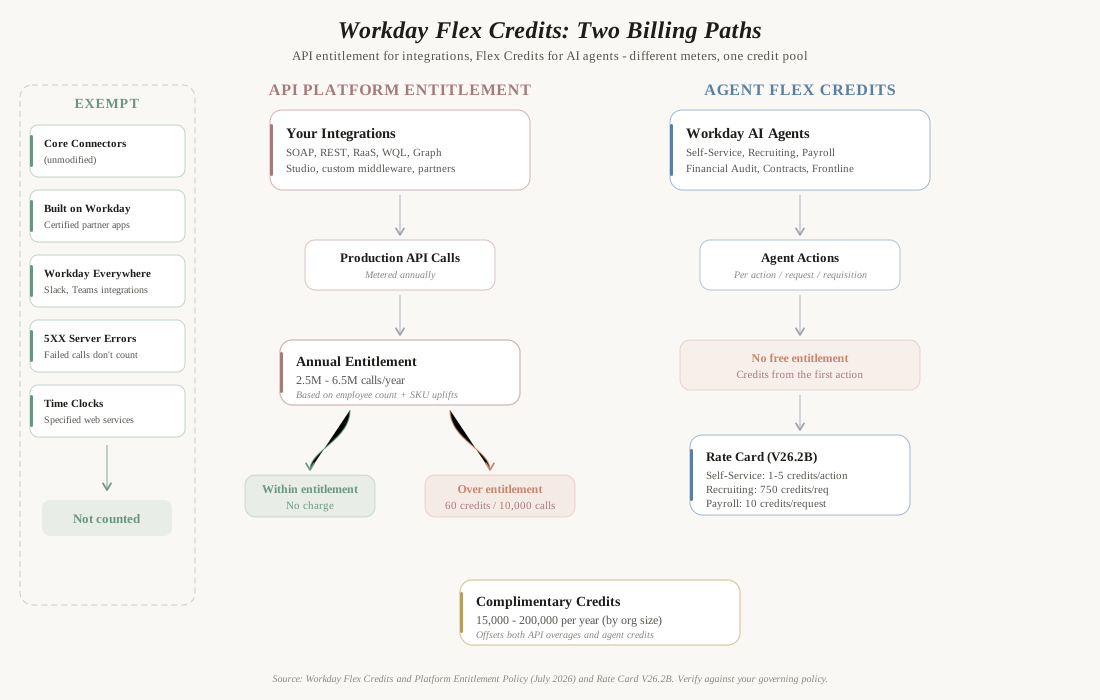
Platform Entitlements give you an annual budget of production API calls. The budget depends on your company size - from 2.5 million calls for organizations under 3,500 employees to 6.5 million for those with 100,000+. Certain licensed SKUs increase this baseline: Financials adds 15%, Extend adds 50%, Procurement adds 100%, and Student adds 150%.
Flex Credits are the currency for anything above your entitlement. API overages cost 60 credits per 10,000 calls. AI agents consume credits from the first action - there's no free entitlement for agents. The rate card (updated October 2026) locks rates for the duration of your order term. Every UMSA customer also receives annual complimentary credits - from 15,000 for organizations under 3,500 employees to 200,000 for those with 100,000+. Complimentary credits don't roll over; they reset annually.
What happens if you run out? Your access to agents and platform capabilities is not suspended. Usage continues to accrue as a negative balance. Workday issues alerts at 80%, 90%, and 100% of usage, and your account team works with you to purchase additional credits. No service interruption.
The Platform Consumption Console (PCC) is where you see your actual numbers. It shows API usage, entitlements, credit consumption, and up to 13 months of historical data. If you haven't looked at your PCC yet, that's the first thing to do.
What counts against your entitlement
This is where most customers get confused. The billing unit is an API request - but not everything that touches Workday is an API request.
Counted: Production SOAP, REST, and RaaS calls from custom integrations, modified connectors, partner integrations, and middleware. WQL and Graph API calls are likely counted based on their technical classification as API traffic, though the policy doesn't enumerate transports individually.
Exempt: Unmodified Workday-delivered Core Connectors, Built on Workday applications, Workday Everywhere (Slack, Teams integrations), third-party time clocks using specified Workday web services, and 5XX server errors. Workday's own built-in agents have their own credit meter - their underlying API calls reportedly don't count against your API entitlement.
Conditional: EIBs, Studio integrations, and Orchestrate are execution frameworks, not billing units. One EIB run is not automatically one API request. The underlying SOAP/REST/RaaS calls they generate may count, but the integration event itself isn't a standalone meter under the current policy.
The critical nuance: Inbound versus outbound doesn't matter by itself. The September rate card explicitly says standard API calls include both ingress and egress. The questions that matter are: Is it a production API request? Who originated it? Is the integration exempt?
Why this matters more than you think
Most Workday customers have no idea how many API calls their integrations make. They know they have 15 integrations, or 30, or 50. They don't know the aggregate request volume.
A single integration that polls Workday every minute generates 525,600 API calls per year - just from polling, before it does any actual work. A middleware platform that syncs employee data nightly across 10 entities might generate 3 to 5 million calls annually. An AI-powered tool like Assistly or a Claude-based MCP integration can amplify a single user question into 5 to 25 API calls through lookups, pagination, and enrichment.
Add those up and a mid-market organization with moderate integration complexity can easily exceed its 2.5 to 3.5 million call entitlement.
What to do now
1. Pull your PCC numbers. The Platform Consumption Console shows your actual API traffic. Pull the API Activity Reports - monthly trends, top API request sources, top IP addresses, and top API names. You need a baseline before you can optimize.
2. Classify your integrations. For every integration, determine whether it's exempt (unmodified Core Connector), countable (custom/partner/modified), or conditional (EIB/Studio). This classification drives your forecast.
3. Identify your top consumers. The PCC reports show which integrations generate the most traffic. Focus on the top 5 - they usually account for 80% of the volume.
4. Optimize high-frequency patterns. Replace polling with event-driven triggers. Switch from row-by-row writes to batch operations. Add caching for stable reference data. Reduce retry loops. These architectural changes can cut API consumption by 30 to 70%.
5. Model your forecast. Use a tool like our Flex Credits Calculator to estimate your annual consumption against your entitlement. Then model what happens at current growth rates over 12, 24, and 36 months.
6. Negotiate at renewal. Come to the table with data, not guesses. Your PCC numbers, integration classification, and consumption forecast give you a factual basis for entitlement discussions.
The opportunity for Workday partners
For organizations working with a Workday partner, this is a moment to audit the integration architecture. A partner who understands both the technical patterns (where API calls come from) and the commercial model (what counts and what doesn't) can turn this from a cost surprise into a managed expense.
AssistNow offers a Consumption Baseline Assessment that ingests your PCC data, classifies your integration portfolio, and models your 12-month forecast. We also optimize the integration architecture to reduce unnecessary API consumption.
Frequently asked questions
When does Flex Credit billing start for API overages? Multiple licensing analyses report a grace period through January 31, 2027. After that date, excess API consumption above your entitlement is expected to draw down Flex Credits. Verify the enforcement date with your Workday account team.
How much does a Flex Credit cost in dollars? Workday states a single Flex Credit starts at $0.10 USD. Negotiated pricing varies by volume and contract; $0.055 is a common midpoint estimate for planning purposes.
Do non-production (sandbox) API calls count? No. Actions taken for testing and evaluation in non-production environments do not consume Flex Credits or count against your Platform Entitlement. This means you can test agents and integrations in sandbox at no cost - a critical advantage for piloting before committing to production usage.
Does my entitlement reset annually? Yes. Both the Platform Entitlement and complimentary Flex Credits reset each contract year. Unused credits and entitlement do not roll over.
What happens if I run out of credits? Your access is not suspended. Usage accrues as a negative balance, and Workday works with you to purchase additional credits. Alerts fire at 80%, 90%, and 100%.
Do AI agents require specific product SKUs beyond the UMSA? Many do. For example, the Recruiting Agent requires HiredScore AI for Talent, the Payroll Agent requires Workday-native Payroll, and the Frontline Agent requires Core HCM plus Scheduling. The Deployment Agent, Self-Service Agent, and several platform agents require only the UMSA. Check your SKU coverage before planning agent adoption.
Estimate your Flex Credit exposure with our free calculator, or request a Consumption Baseline Assessment.
Ready to Improve Your Workday?
See how Assistly® can streamline your Workday environment with 68% ticket deflection and proactive support that prevents issues before they occur.